A THIRD RESEARCH METHODOLOGY

Some meaning is lost the moment it becomes only words or only numbers.

Quaillustrative Research Methodology (QRM) is an inclusive, multisensory approach to inquiry — developed by Dr. Earney F. Lasten and set alongside quantitative and qualitative research, not beneath either.

01 — Where it stands

Quantitative asks how much. Qualitative asks what it means. Quaillustrative asks what it's like.

Numbers record position. Words describe meaning. QRM captures what neither can hold on its own — the sensory, contextual, and experiential texture of a phenomenon — through sketches, illustration, sound, texture, and multisensory representation, gathered and analyzed with the same rigor as any other method.

Quantitative

Numbered positions

Records what can be counted, measured, and compared. Answers "how much" and "how many."

Qualitative

Meaning in words

Describes what things mean to the people living them, through language and interpretation.

Quaillustrative

Holistic, multisensory illustration

Integrates both, plus hue, glow, sound, and context that words and numbers cannot capture on their own.
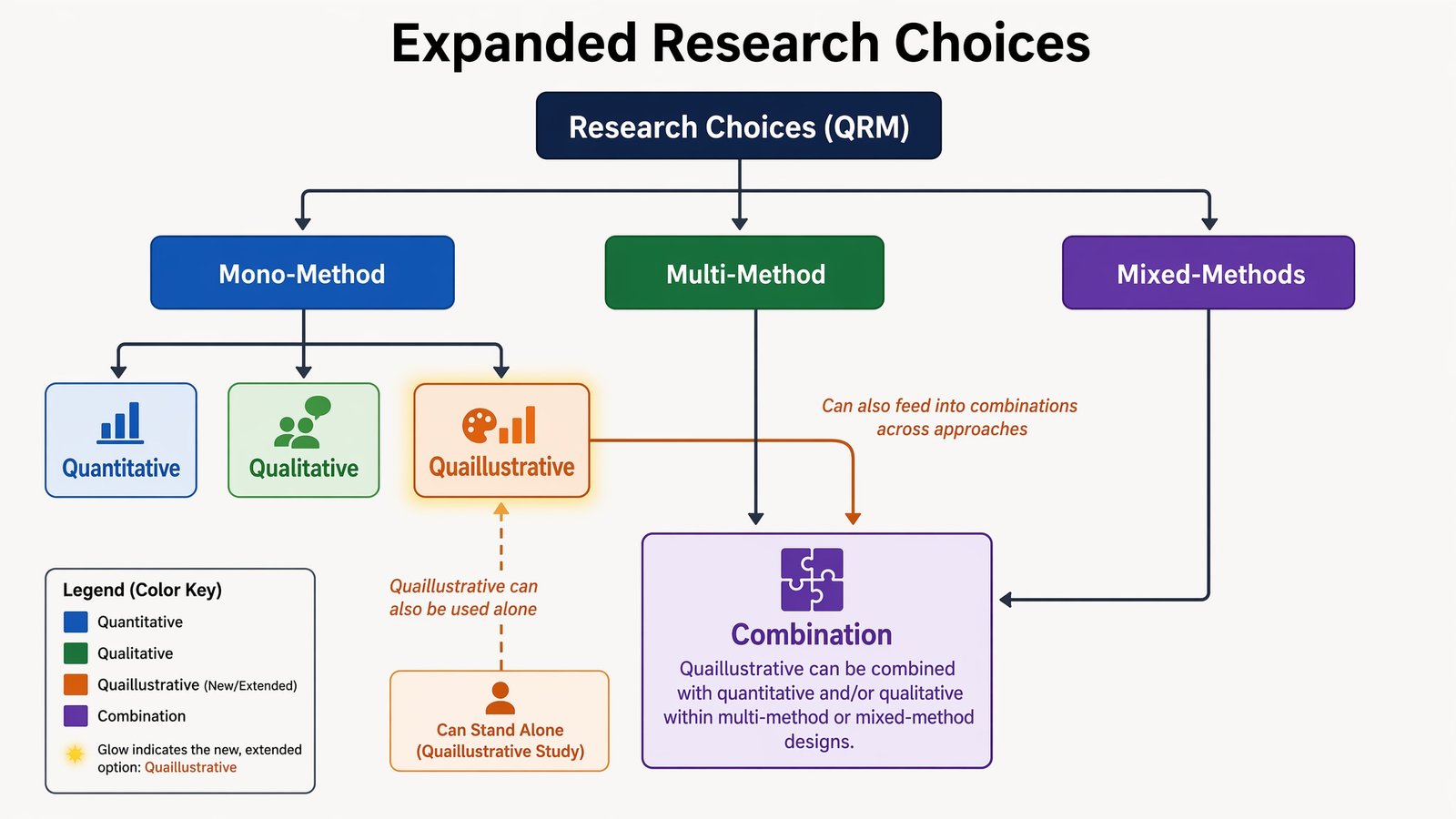
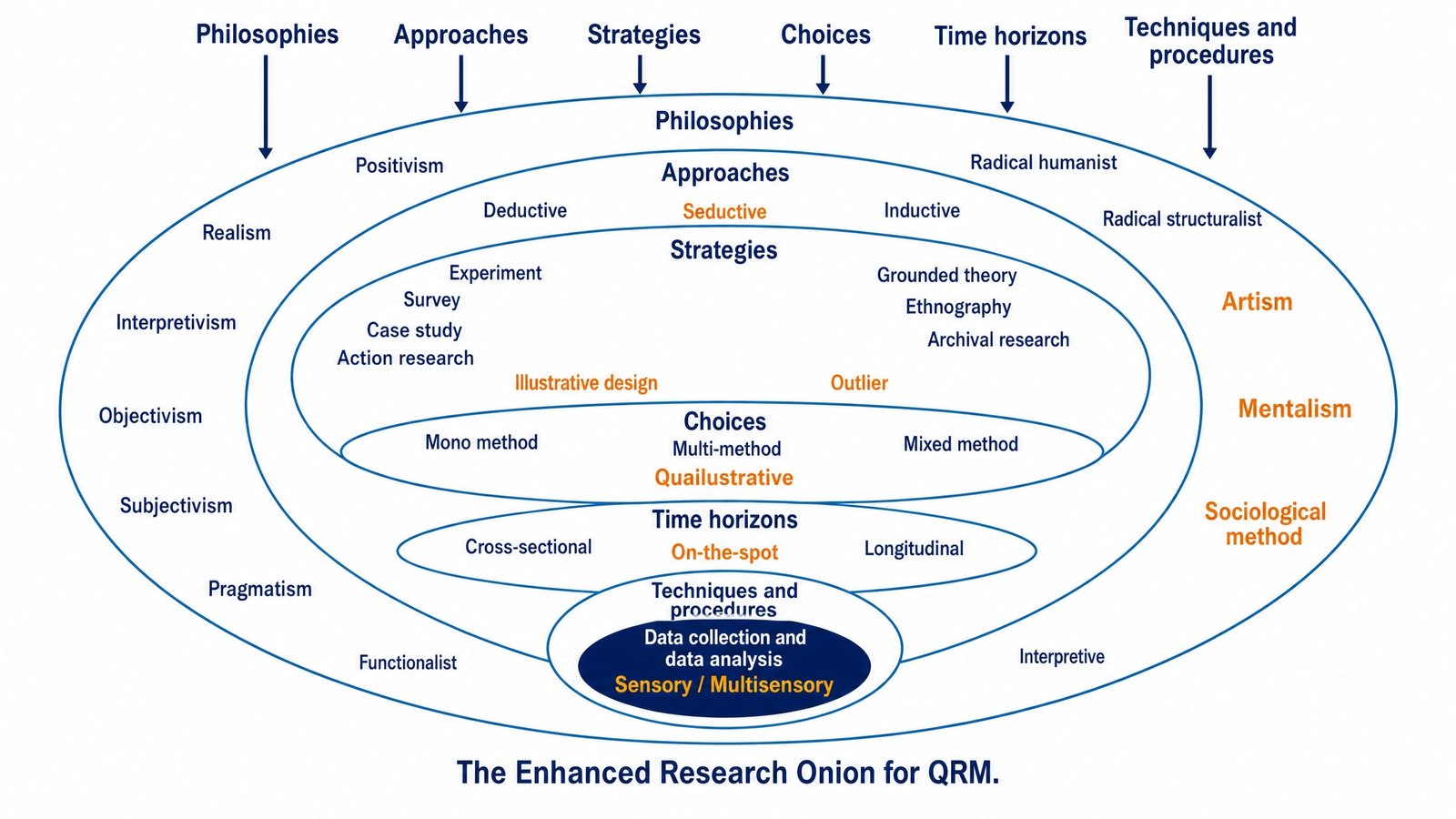
Diagram: Expanded Research Choices tree showing Mono-Method, Multi-Method, and Mixed-Methods, each able to include a Quaillustrative option, converging on Combination.
Fig. 1 — QRM does not replace the existing choices; it extends them. A study can be Quaillustrative alone (mono-method), combined with quantitative and/or qualitative work (multi-method), or folded into a mixed-methods design.

02 — The Enhanced Research Onion

QRM extends every layer researchers already plan through.

Saunders' research onion is the standard planning tool for a study's philosophy, approach, strategy, choice, time horizon, and technique. QRM adds a corresponding option at each layer, shown here in amber.

Diagram: The Enhanced Research Onion for QRM, adding a Seductive approach, Illustrative design strategy, Quailustrative choice, On-the-spot time horizon, and Sensory/Multisensory technique alongside the traditional layers.
Fig. 2 — The Enhanced Research Onion for QRM. Each traditional layer gains a QRM-native counterpart, without displacing the original options.

Philosophies

Alongside positivism, interpretivism, realism, and pragmatism, QRM grounds itself in three philosophies of its own: Artism — artifacts (sketches, models, objects) as legitimate carriers of knowledge in their own right; Mentalism — mentifacts, the intuitive and pre-verbal understanding that precedes or exceeds language; and the Sociological Method — sociofacts, the values and social structures a community reveals through what it sketches, models, or gestures toward, rather than only through what it says.

Approach

Alongside deductive and inductive reasoning, QRM proposes a seductive approach — drawing the participant or reader in through sensory and visual appeal before analysis begins.

Strategy

Alongside experiment, survey, case study, ethnography, and grounded theory sits illustrative design and the outlier strategy — treating the atypical case as data-rich rather than noise to discard.

Choice

Alongside mono-, multi-, and mixed-method sits the Quaillustrative choice — usable standalone or combined with either of the established approaches.

Time horizon

Alongside cross-sectional and longitudinal studies sits on-the-spot analysis — the shortest timeline of all, where discovery arises immediately from a single sensory encounter.

Technique

Alongside standard data collection and analysis sits a sensory / multisensory layer — sketching, modeling, sensory mapping, tactile diary methods, and data physicalization — the operational core where QRM is actually practiced.

03 — Seeing the difference

The same object, three methodologies.

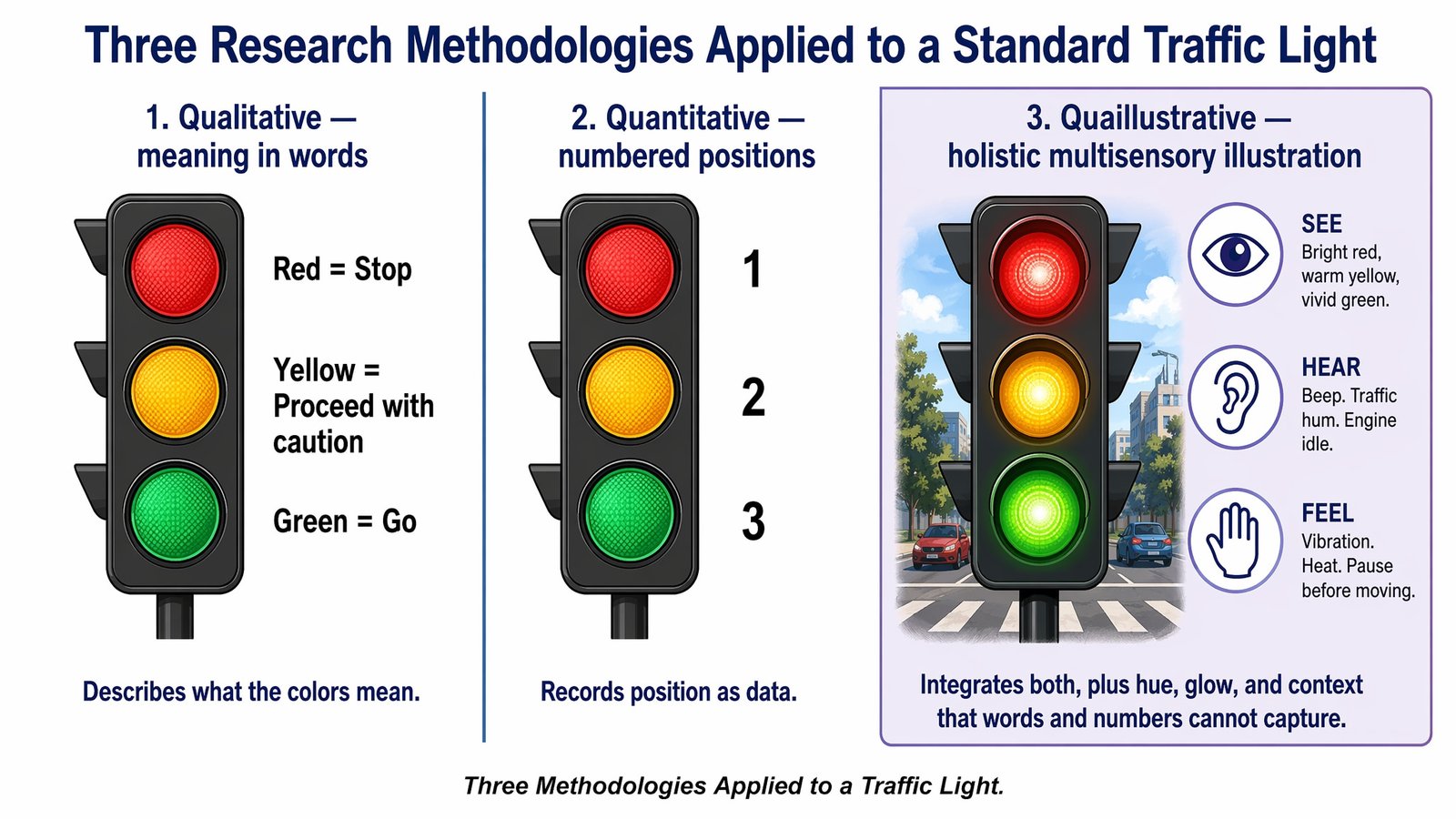
A traffic light is a small, familiar object — useful precisely because it makes the distinction concrete rather than abstract.

Diagram: Three research methodologies applied to a standard traffic light — qualitative describes meaning, quantitative records numbered position, quaillustrative integrates sight, sound, and feel.
Fig. 3 — Qualitative research tells you red means stop. Quantitative research records that red is position one. Quaillustrative research holds the beep, the engine idle, the pause before moving, and the glow of the light together — the full, embodied moment a survey or interview alone would flatten.

Why this matters beyond the example

In heritage attractions, museums, urban planning, and community engagement, the moment that actually persuades a stakeholder is rarely a statistic or a quote — it's a sketch, a model, a soundscape, a texture placed in someone's hands. QRM gives that moment a name, a place in the research onion, and a method for gathering and analyzing it with the same discipline as any other data.

04 — The full framework

QRM in context: The Experience Masterplan.

Chapter 31 is one part of a complete, 799-page blueprint for planning, designing, funding, and delivering world-class attractions — from heritage sites and museums to theme parks, urban developments, and adaptive-reuse projects. QRM sits inside that larger 26-step framework, used throughout the book for stakeholder engagement, co-design, and inclusive data collection.

Built for two audiences at once: a working reference for practitioners and consultants, and a full semester's course material for instructors — exercises, discussion questions, and case studies included in every chapter.

The Experience Masterplan

A Universal Blueprint for Planning, Designing, Funding, and Delivering World-Class Attractions and Projects

AuthorEarney Lasten
FormatHardcover, full color, 8.5 × 11 in
Pages799
PublishedJul 14, 2026
ISBN9781105061479
PriceUSD 173.44
Buy the hardcover on Lulu

Printed on demand, usually ships in 3–5 business days.

05 — Where QRM stands today

Developed, published, and under peer review.

Ch. 31
Quaillustrative Research Methodology, in The Experience Masterplan (ViaMoon Press)
25+
peer-reviewed publications by the developer, Dr. Earney F. Lasten
In review
A dedicated QRM manuscript is currently submitted for peer review
UCF · 2010
Doctoral foundation, Rosen College, advised by Dr. Abraham Pizam

06 — Part of a wider practice

Built alongside a family of platforms.

QRM grew out of the same practice that built these — strategic consulting, SaaS, and inclusive e-learning across the Caribbean and Latin America.

Primary

viamoon.com

Strategic consultancy and SaaS platform productizing Dr. Lasten's doctoral planning blueprint for tourism, hospitality, and destination development.

Visit viamoon.com →

Plan a study using QRM.

Walk through the enhanced research onion layer by layer and get a research-design summary you can take into a proposal.

Open the Copilot